
Run a recruitment pipeline
Learn HR · Generalist HR Lifecycle · Task A3. Turn an open role into the right hire — fairly, quickly, and with a record you can defend.
What it is
Recruitment is a pipeline: a set of candidates moving through ordered stages, narrowing at each one until the best-fit person is hired. The canonical funnel:
Applied → Screening → Interview → Offer → Hired (with Rejected as the exit at any stage).
Two ideas make it a discipline rather than a scramble:
- A structured process. Everyone is measured against the same criteria at each stage — the same screening checklist, the same interview questions scored the same way. Structured interviews are the single biggest predictor of a good hire and the main defence against bias.
- It's a funnel, so it has metrics. How many applied, how many survived each stage, how long each stage took. The ratios tell you whether the problem is too few applicants (sourcing) or the wrong ones (targeting) or too slow (losing good people to faster employers).
The HR officer owns the process and the record; the hiring manager owns the decision.
Why it matters
- Quality of hire is the highest-leverage thing HR does. A good hire compounds for years; a bad one costs months of management time and a re-run of the whole pipeline.
- Speed is competitive. Good candidates are off the market in weeks. A pipeline that stalls in "screening" for a month loses them to employers who moved faster.
- It has to be defensible. A rejected candidate (or a regulator, or a works council) can ask why. "We scored everyone against the same criteria, here's the record" is an answer; "the manager had a feeling" is a lawsuit.
- It's the front door to everything downstream. A hire hands off to onboarding (A4), a headcount line (A1), and a payroll record — so a clean pipeline keeps the whole employee lifecycle clean.
Where you do it in VanillaPM
Everything below is in Recruitment (the org-level workspace, apps/recruitment).
A step-by-step:
-
Open the vacancy. Click New vacancy — give it a title, the number of openings, and a status (Open · On hold · Closed). Raise it from an establishment post to link the hire to a real position and org unit (so it traces to a box on the org chart, not a floating headcount), or raise a free-standing one.
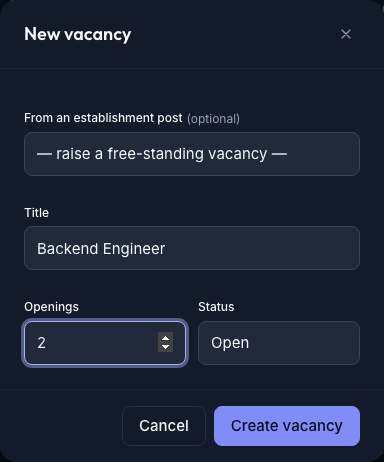
The New vacancy form — title, number of openings, and status; optionally raised from an open establishment post so it links to a real position and org unit -
Add applicants to the pipeline. Open the vacancy and Add applicant — name, and optionally email, phone, and a link to the CV. Each one enters at the Applied stage. The vacancy list shows the live pipeline counts right on the card (Applied N · Interview N · Hired N).
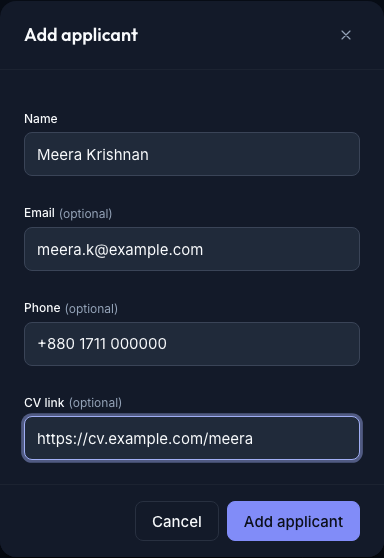
The Add applicant form — name (required) plus optional email, phone, and a CV link; the applicant enters the pipeline at the Applied stage -
Advance them stage by stage. Each applicant row has a → next stage button that moves them forward one step — Applied → Screening → Interview → Offer → Hired — or a Reject button. The applicant only ever moves one stage at a time, so the pipeline always reflects where each person truly is.
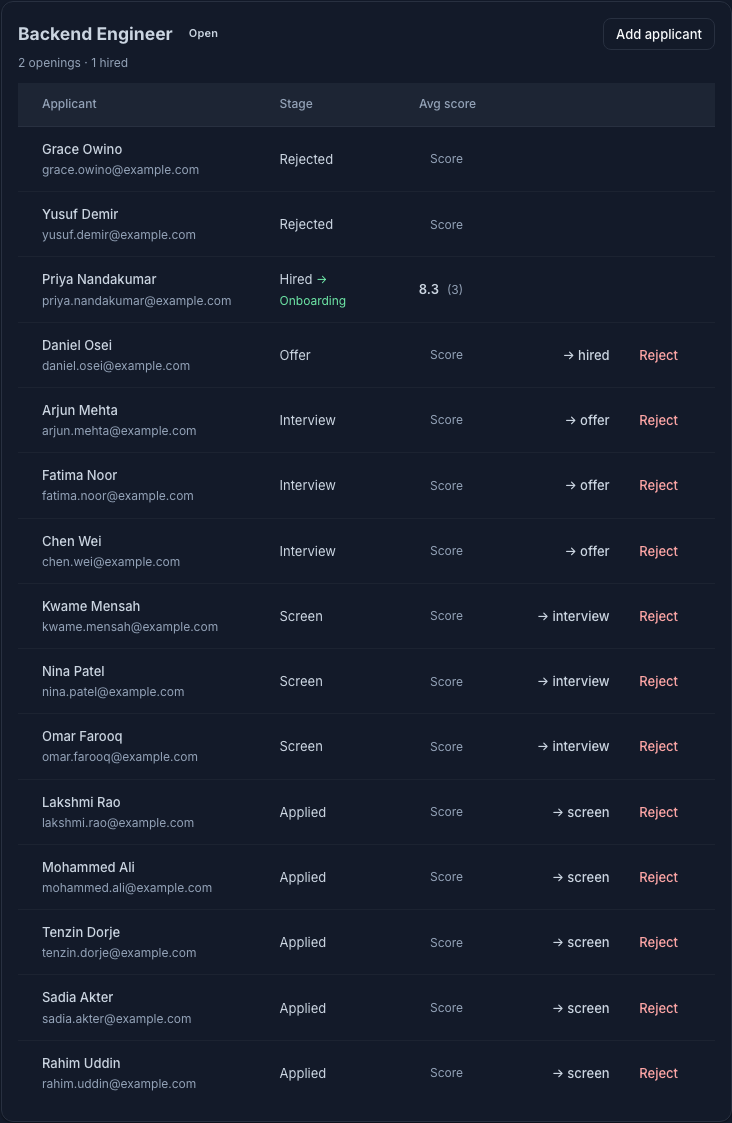
The applicant pipeline — every candidate at their stage, with a → next-stage button and a Reject button on each live row; the average interview score shows alongside, and a hire is flagged → Onboarding -
Score the interview — structured. At the interview stage, open an applicant's score and record interview feedback: the panelist, a 0–10 score, and a note. Each panelist's score is captured separately — and the row shows the average — which is what makes the decision comparable across candidates and defensible afterwards, not one averaged gut feel.
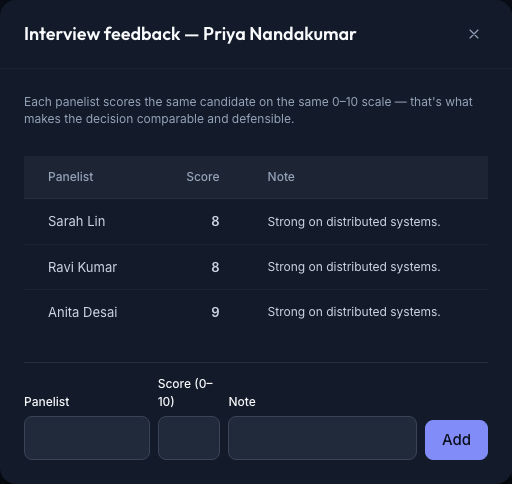
The interview-feedback panel — each panelist's 0–10 score and note recorded separately against the candidate, with the average shown on the pipeline row (here 8.3 across three panelists) -
Make the offer, then hire. Move the chosen candidate to Offer, then Hired (which stamps the hire). The remaining active candidates are rejected (keep them warm — they're your shortlist for the next opening).
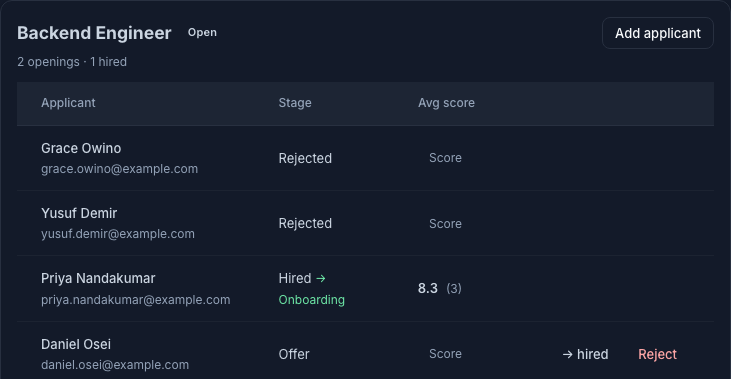
The offer-and-hire end of the pipeline — an Offer-stage candidate with a → hired action, and the hired candidate stamped Hired and flagged → Onboarding -
Hand off to onboarding. A hire is flagged → Onboarding right on the pipeline row (see above) and flows straight to onboarding (A4) — the pipeline's job ends where the new-joiner's begins, with no re-keying of the person's details.
Walked example — Meridian hiring a Backend Engineer
You're the HR officer at the multinational building Meridian, its internal payments platform (the same project the finance track costs). Engineering needs two backend engineers. (Figures illustrative until the corporate seed lands.)
- You raise a vacancy — Backend Engineer, 2 openings, under the Platform Engineering unit.
- Over two weeks, 40 applicants apply. Screening (CV + a short call against a fixed checklist) passes 12 to interview.
- A three-person panel interviews each, scoring 0–10 on the same five competencies. Priya Nandakumar averages 8.3; the panel's notes agree she's strong on distributed systems.
- Two offers go out (Priya + one other); both accept and move to Hired. The other 10 are rejected with a note — and kept on file for the next req.
- Both hires hand off to onboarding; the vacancy closes.
The whole thing left a record: who applied, who advanced, every panelist's score, and why the two were chosen — exactly what you'd need if applicant #11 asked why they didn't get it.
The records — what the pipeline captures
The funnel is the dataset. From the Meridian req:
| Stage | Count | Stage conversion |
|---|---|---|
| Applied | 40 | — |
| Screening | 12 | 30% |
| Interview | 12 | 100% |
| Offer | 2 | 17% |
| Hired | 2 | 100% |
What an HR officer reads from it: - Applied → Screening 30% — healthy targeting (not drowning in unqualified CVs). - Interview → Offer 17% — a high interview bar; fine if deliberate, a red flag if you're running out of candidates and interviewing everyone. - Time in stage (from each application's timestamps) — if applicants sit in Screening for weeks, that's where you're losing people. - Panel score spread — if one panelist scores everyone 3 points higher, your criteria aren't being applied consistently.
Controls & assurance
What makes a pipeline fair and defensible:
- Same criteria for everyone — a fixed screening checklist and scored interview questions, so decisions are comparable, not personal.
- Documented scores and reasons — every panelist's 0–10 score and the hire/reject reason are on the record, not in someone's memory.
- Traceable to a real role — the vacancy links to a position + org unit, so you can't hire into a headcount that doesn't exist.
- Non-discrimination — the structure is the control: measuring everyone the same way is how you evidence an EEO-compliant, bias-reduced process.
- Candidate-data care — CVs and contact details are personal data; hold only what you need and only as long as you need it (your retention policy, not a free-for-all).
Best practices & pitfalls
- Do define the scorecard before you open the vacancy — decide what "good" looks like before you meet anyone, so the first charismatic candidate doesn't redefine the bar.
- Do move fast through the early stages; speed is how you keep the best candidates in the funnel.
- Do keep rejected-but-strong candidates on file — your next opening's shortlist is already here.
- Pitfall: the unstructured "chat" interview. It feels friendly and predicts almost nothing; it's also the least defensible if a decision is ever challenged.
- Pitfall: advancing on a single champion's enthusiasm. Record all the panel scores — one loud yes isn't a structured decision.
- Pitfall: a vacancy with no position/unit link — a "ghost" hire that breaks headcount and payroll reconciliation downstream.
Practise question
Q1. A vacancy has 80 applied, 8 interviewed, 0 offers after three weeks, and the hiring manager wants to "just pick the best of the eight." As the HR officer, what does the funnel tell you, and what do you do?
Answer: Applied→Interview is only 10% and Interview→Offer is 0% — the manager is interviewing a thin slice and still finding no one acceptable. That's a sourcing/targeting problem (the right people aren't in the funnel), not a reason to lower the bar. Re-open sourcing against the scorecard rather than offering to a candidate no one actually rated — hiring the "best of a bad eight" is how a bad hire enters, and the scored record will show the offer wasn't justified.
Terms used here
- Vacancy — an approved open role (title · openings · position · org unit · status).
- Pipeline / funnel — the ordered stages candidates move through: applied → screen → interview → offer → hired (→ rejected).
- Structured interview — the same questions, scored on the same scale by a panel, for every candidate — the strongest predictor of a good hire.
- Conversion rate — the share of candidates passing from one stage to the next.
- Interview feedback — a panelist's recorded score (0–10) and note against an application.
- Related: Onboard a new hire — where a hire becomes a productive joiner.
What an auditor / hiring manager expects
They expect a defensible, consistent record: every candidate scored against the same criteria, every panel score and hire/reject reason documented, and the hire traceable to a real approved position. A pipeline you can't explain is a hiring decision you can't defend — and in HR, "we did it the same way for everyone, here's the evidence" is the whole game. The funnel metrics tell you whether the process is healthy; the record tells everyone else that it was fair.